Engines, Steering & Anchors Guide
Use engines, steering and anchors to control larger rafts and make story travel far less painful.
← Raft Guide Hub · Progression Route · Resources
When propulsion unlocks
You discover the Engine and Steering Wheel blueprints at Vasagatan. Powered travel becomes particularly important for Balboa, where the current can oppose your intended route. Research the required components before building, and keep sufficient plank fuel for the trip.
Engine placement and power
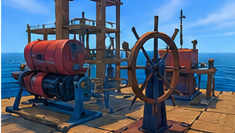
Mount the Engine with the paddle wheel in open water; blocking its rotation or placing it incorrectly prevents useful propulsion. One Engine handles up to roughly 100 foundations, so larger rafts need additional engines. Ensure the required engines are running rather than expecting one motor to push an enormous floating building.
Steering Wheel
Use the Steering Wheel to rotate and guide the raft while engines provide forward or backward thrust. Install it where the helmsman can see the sea and reach the Receiver. Check the direction of all engines if the raft fails to move as expected; mismatched directions can cancel out useful travel.
Anchor progression
A Throwable Anchor is a cheap one-use stop for early islands. Upgrade to a Stationary Anchor for repeat visits and later to the Advanced Stationary Anchor, which works with Engine Controls. Do not sail away with an anchor deployed, and make sure the anchor has correct clearance to operate.
Biofuel and remote controls
The Biofuel Refiner, Fuel Tank and Fuel Pipes support efficient long-distance engine use once unlocked. Engine Controls allow multiple motors to be operated together. A practical layout keeps the helmsman, Receiver and control panel near one another.
Troubleshooting
If engines stall, check fuel, paddle-wheel clearance, number of foundations, anchor status and whether engines face compatible directions. If the Receiver shows a destination against the current, plan a powered crossing and ensure fuel reserves are sufficient.
Engine diagnosis order
If the raft does not move, check in this order: Is an anchor down? Are the engines fuelled and switched on? Are their paddle wheels clear of obstructions? Do all engines point in a compatible direction? Does the total engine capacity match your foundation count? Only after these checks should you rebuild your navigation layout.
Foundation count versus engines
One normal Engine supports up to approximately 100 foundations. Add another engine for each further block of roughly 100 foundations until reaching six engines; six can power even very large rafts. Count foundations rather than floors, sails or the number of storage boxes. If your raft is unusually large, do not assume one engine will work because the wheel is visibly turning.
Docking procedure
- Reduce speed and align the raft with a safe approach.
- Stop engines when near the dock or shoreline.
- Drop the anchor only when positioned correctly.
- Check that the raft is stationary before going ashore.
- On return, refill supplies, raise the anchor and restart propulsion.
For island visits without powered travel, a Throwable Anchor is adequate early on, but it must be recrafted after use. A Stationary Anchor is a strong quality-of-life upgrade for repeated stops.