Collection Nets Guide
Use Collection Nets to automate debris gathering and build a stronger long-term resource economy.
← Raft Guide Hub · Progression Route · Resources
Why nets matter
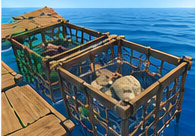
Collection Nets automatically collect floating surface debris that intersects their footprint. Their value is not simply extra loot, but time: while nets work, you can farm, explore, build and manage water production rather than spending every moment throwing a hook.
Placement
Put nets in a row across the path taken by debris relative to the raft's movement. A broad crosswise collection line generally catches more than a small cluster tucked behind buildings. Watch the debris stream for a few minutes to confirm where objects approach, then expand that edge.
Emptying and maintenance
Check nets regularly so their catch capacity is not wasted. Store common plastic and planks nearby for building and fuel. Keep the collection line accessible by walkway so you can empty each net safely. Protect vulnerable foundations with Foundation Armor as resources allow.
How nets interact with rafting
Your raft passes through debris streams as it sails; turning or drifting changes the angle at which the material reaches the nets. If net intake looks poor, look at your travel direction before building dozens more. Large nets and improved layouts should complement, not replace, a sustainable food-and-water system.
Common design errors
Building a thin collection line in the direction of travel leaves many objects passing to either side. Completely enclosing the nets can make them annoying to empty. Overspending on nets when you cannot afford water or repairs is also a trap; start small and extend as materials accumulate.
Recommended layout
Begin with a straightforward straight line of nets at a practical raft edge, with storage and crafting nearby. Leave walking access and account for future engines or anchor placement. Once resource intake is steady, optimise the rest of the raft around the saved time.
Check net efficiency
Stand at the edge while the raft moves and watch whether barrels, plastic or planks are consistently passing outside the catch line. If so, extend the line sideways rather than making it deeper in the same direction. Keep the front-facing walkway open and put a plank-and-plastic chest nearby for quick repairs.
Step-by-step field checklist
- Observe the debris flow in relation to the moving raft.
- Place a short crosswise line of Collection Nets.
- Keep a safe walkway so each net can be emptied.
- Extend the line sideways when debris consistently bypasses its ends.
- Protect important outer foundations and store captured supplies close by.
What to do if progress stalls
If your collection is weak, don't automatically double the number of nets. First confirm orientation, movement and whether the debris is passing outside the line. A poorly positioned large net array can still miss most objects.
Preparation and practical takeaway
A simple line of accessible nets with nearby chests beats complicated enclosed geometry that slows collection.